Wednesday, November 9, 2016

Optics applets/animation

Refraction, in general:

http://www.absorblearning.com/media/item.action?quick=15n


And for lenses:


Recall also what happens when light hits mirrors (flat and curved).

Exam 2 review

Exam 2 topics:


Energy
Basics of flight; Bernoulli effect


waves
- wavelength
- frequency
- speed
-amplitude
- crests and troughs

wave speed = frequency x wavelength
(Note that the wave speed is the speed of light when you are talking about electromagnetic waves.)

mechanical vs. electromagnetic waves

harmonics on a string - "standing waves"

music - octaves, the next note on the piano (1.0594)

Doppler effect
- red shift, blue shift

light reflection

light refraction

lenses and mirrors (convex and concave)

focal length/point

predicting light paths (when light is reflected or refracted)

electromagnetic spectrum - radio, micro, IR, visible, UV, X, gamma


Monday, November 7, 2016

Optics questions

Optics questions - answers forthcoming

1.  Review the concept of reflection, particularly the law of reflection.  Draw what happens when a light ray hits a mirror at various angles.

2.  Review the concept of refraction:  what it is, what causes it, what happens during it, under what circumstances does light bend, etc.  Draw what happens when a light ray hits a block of transparent plastic at various angles.  

3.  Show how to calculate the wavelength of WTMD's signal (89.7 MHz).


4.  Some questions related to how light is affected by optics.


Answers:

Wednesday, November 2, 2016

Light - 3. Refraction

Refraction:


Consider a wave hitting a new medium - one in which is travels more slowly. This would be like light going from air into water. The light has a certain frequency (which is unchangeable, since its set by whatever atomic process causes it to be emitted). The wavelength has a certain amount set by the equation, c = f l, where l is the wavelength (Greek symbol, lambda).
When the wave enters the new medium it is slowed - the speed becomes lower, but the frequency is fixed. Therefore, the wavelength becomes smaller (in a more dense medium).
Note also that the wave becomes "bent." Look at the image above: in order for the wave front to stay together, part of the wave front is slowed before the remaining part of it hits the surface. This necessarily results in a bend.

MORE DETAIL:


The general rule - if a wave is going from a lower density medium to one of higher density, the wave is refracted TOWARD the normal (perpendicular to surface) line. See picture above.


Refraction is much different than reflection. In refraction, light enters a NEW medium. In the new medium, the speed changes. We define the extent to which this new medium changes the speed by a simple ratio, the index of refraction:
n = c/v
In this equation, n is the index of refraction (a number always 1 or greater), c is the speed of light (in a vacuum) and v is the speed of light in the new medium.
The index of refraction for some familiar substances:
vacuum, defined as 1
air, approximately 1
water, 1.33
glass, 1.5
polycarbonate ("high index" lenses), 1.67
diamond, 2.2
The index of refraction is a way of expressing how optically dense a medium is. The actual index of refraction (other than in a vacuum) depends on the incoming wavelength. Different wavelengths have slightly different speeds in (non-vacuum) mediums. For example, red slows down by a certain amount, but violet slows down by a slightly lower amount - meaning that red light goes through a material (glass, for example) a bit faster than violet light. Red light exits first.
In addition, different wavelengths of light are "bent" by slightly different amounts. This is trickier to see, but it causes rainbows and prismatic effects.

Some animation, etc.:

http://faraday.physics.utoronto.ca/PVB/Harrison/Flash/Waves/Refraction/Refraction.html

http://www.animations.physics.unsw.edu.au/jw/light/Snells_law_and_refraction.htm

http://www.freezeray.com/flashFiles/Refraction2.htm


And all of this helps explain how lenses form images.

Light - 2. Reflection.


Reflection - light "bouncing" off a reflective surface. This obeys a simple law, the law of reflection!

The incident (incoming) angle equals the reflected angle. Angles are generally measured with respect to a "normal" line (line perpendicular to the surface).

Note that this works for curved mirrors as well, though we must think of a the surface as a series of flat surfaces - in this way, we can see that the light can reflect in a different direction, depending on where it hits the surface of the curved mirror.

So - light reflects from mirrors, according to the law of reflection.  However, if the mirrors is curved, light still obeys this rule - it just looks a bit different.  You have to visualize the curved mirror as a series of little flat mirrors.

A convex mirror (top) acts reflects light rays "outward" - the light rays seem as though they are coming from inside the convex mirror, so it seems as though there is an image inside.  We call this a VIRTUAL IMAGE.  Think of convenience store mirrors or side view mirrors.

 A concave mirror (bottom) acts sort of the opposite way.  The parallel light rays bend "inward" - so the light rays converge at a FOCAL POINT.  Where they meet, an image is formed - we call this a REAL IMAGE.

Note however that this happens in this case because the light rays were initially parallel (which is what happens if the object the light rays reflect from is far away).  If they are NOT initially parallel - in other words, if the object is reasonably close to the mirror, the rays may converge at some other point.  Examples of concave mirrors are found in makeup/shaving mirrors and reflecting telescope mirrors.  But again - the light rays ONLY meet at the focal point IF they were initially parallel.  If not, they meet elsewhere (or maybe not at all).  More about this next class when we talk about refraction and lenses.


Light - 1

Recall that waves can be categorized into two major divisions:

Mechanical waves, which require a medium. These include sound, water and waves on a (guitar, etc.) string

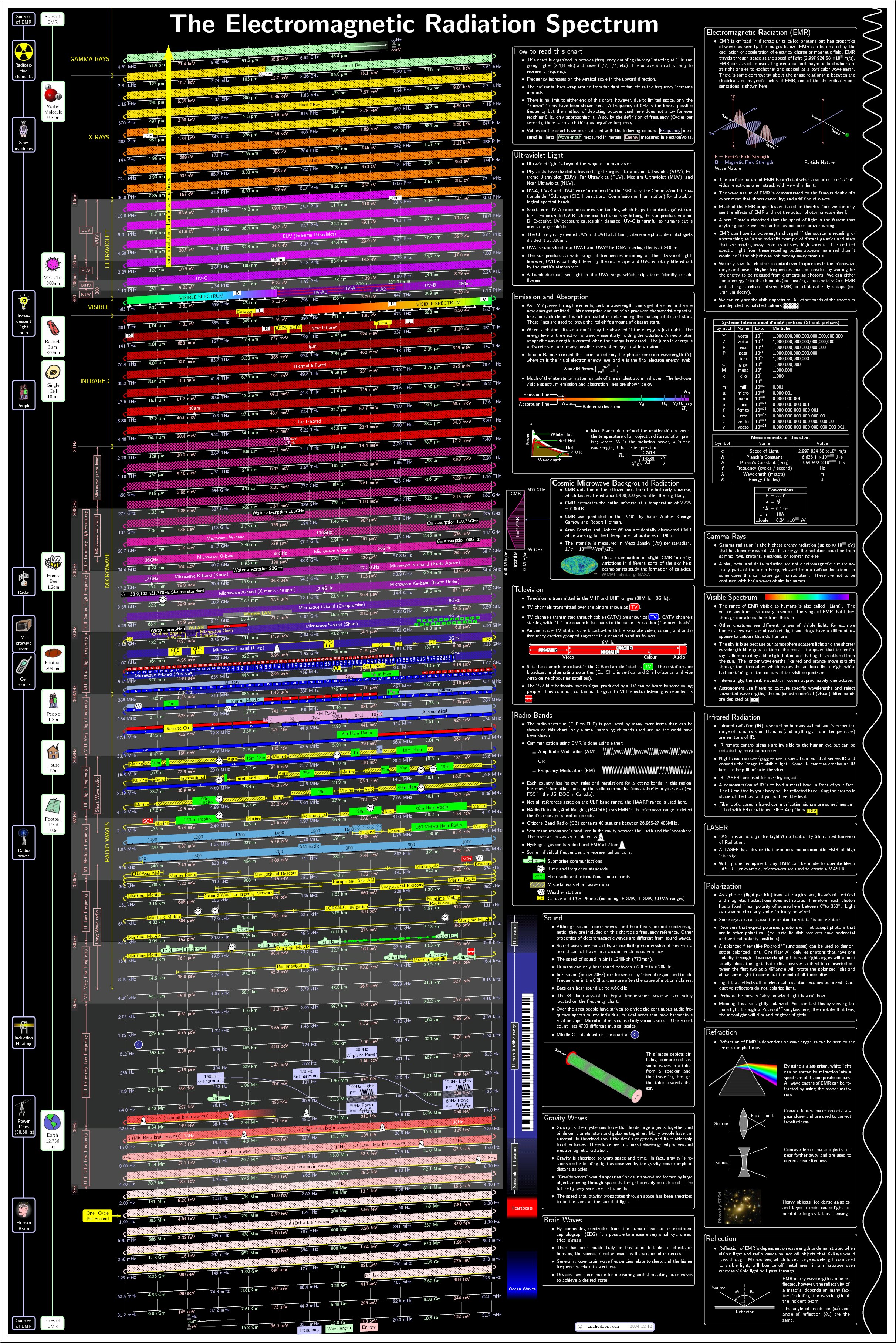
Electromagnetic waves, which travel best where there is NO medium (vacuum), though they can typically travel through a medium as well. All electromagnetic waves can be represented on a chart, usually going from low frequency (radio waves) to high frequency (gamma rays). This translates to: long wavelength to short wavelength.

All of these EM waves travel at the same speed in a vacuum: the speed of light (c). Thus, the standard wave velocity equation becomes:


c = f l


where c is the speed of light (3 x 10^8 m/s), f is frequency (in Hz) and l (which should actually be the Greek letter, lambda) is wavelength (in m).

General breakdown of e/m waves from low frequency (and long wavelength) to high frequency (and short wavelength):

Radio
Microwave
IR (infrared)
Visible (ROYGBV)
UV (ultraviolet)
X-rays
Gamma rays

In detail, particularly the last image:


http://www.unihedron.com/projects/spectrum/downloads/full_spectrum.jpg

Don't forget - electromagnetic waves should be distinguished from mechanical waves (sound, water, earthquakes, strings on a guitar/piano/etc.). 

ALL E/M waves (in a vacuum) travel at the SPEED OF LIGHT (c).


Some questions for practice.

Related questions from today's class on the Doppler effect:

1.  What is the Doppler effect?

2.  An ambulance is coming toward you, with a siren blasting a 1000 Hz tone.
a.  As it approaches you, what will be true of the frequency of the sound YOU hear?
b.  After it passes you, what will be true of the frequency of the sound YOU hear?
c.  What is true of the frequency of sound that the ambulance drivers hear?

2.  Be sure to review the websites shown in class.  Remember that the Doppler effect has to do with frequencies, NOT volumes of waves.

3.  What is a red shift?  What is a blue shift?


Also - questions from earlier material (before we did waves):

1.  What is the Bernoulli principle?

2.  Explain the general principle behind why airplanes fly.

3.  In general, what is energy?